
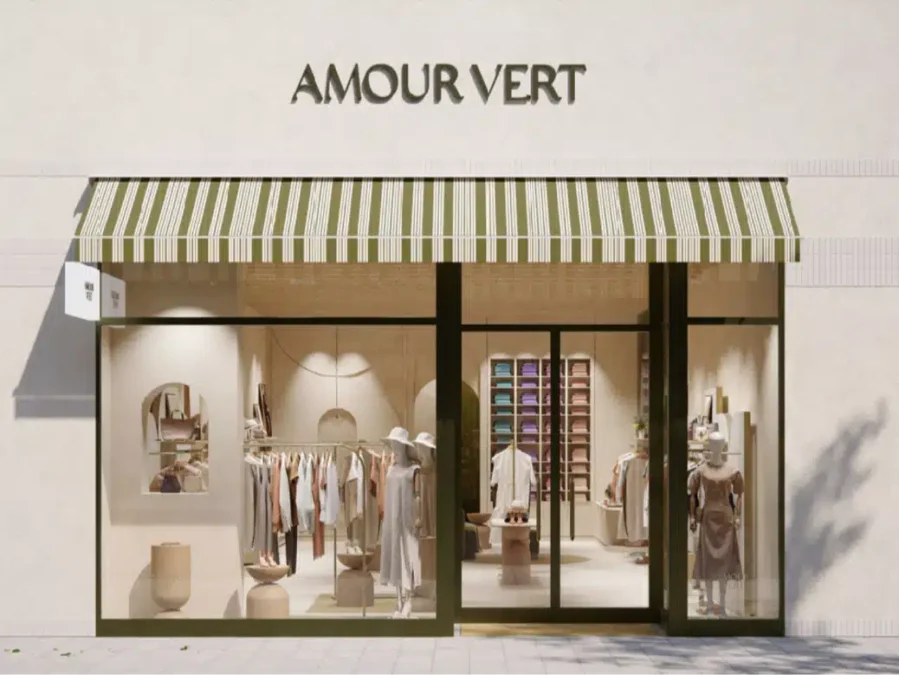

The most important development is the sale process itself. Rock Creek Advisors says it is contacting buyers on behalf of Amour Vert, and the public deal page describes the company as a sustainable women’s apparel brand with strong customer loyalty, projected 40%+ sales growth from 2023A to 2025E, a 2025E gross margin of 61%, and more than 30,000 annual customers. Those figures are from the sale materials, not audited public financials, but they still show why the brand remains attractive in a crowded market. In plain terms, Amour Vert still has brand value, a loyal audience, and a model that buyers may see as worth saving or scaling.
The timing makes the story even sharper. In spring 2024, Amour Vert announced a full rebrand and a move from San Francisco to downtown Los Angeles, positioning itself closer to the fashion district and promising a more modern omnichannel push. Industry coverage also noted the opening of a sixth brick-and-mortar store in Long Beach, with more California locations planned in Irvine and San Diego. That combination of expansion and sale pressure is exactly what makes the brand interesting now: it is not simply fading away, but trying to redefine itself while the market is watching.
The legacy that made Amour Vert matter in the first place
Amour Vert did not become recognizable by accident. Reporting from Stanford Magazine and fashion outlets traces the brand back to the late 2000s and early 2010s, when founders Linda Balti and Christoph Frehsee built a San Francisco label around the idea of “green love,” French-inspired design, and California ease. The company stood out because it was trying to prove that sustainable fashion could feel polished, wearable, and premium instead of earthy or awkward. In a sector often criticized for waste, that was a distinctive position, and it helped Amour Vert earn attention far beyond its size.
The materials story was just as important. Early coverage and later brand materials highlighted organic cotton, TENCEL, modal, silk, hemp, and recycled fibers, plus small-batch production and a tree-planting program tied to T-shirt sales. Those choices turned the label into a talking point for slow fashion and ethical manufacturing, especially among shoppers who wanted wardrobe staples that looked good and carried a lighter footprint. The resale marketplace and circular-fashion angle only strengthened that identity. Even now, that legacy is part of the brand’s value, because it gave Amour Vert a clearer mission than many of its competitors ever managed to build.
Why shoppers are paying attention now
A big reason Amour Vert still matters is that U.S. consumers have not stopped caring about sustainability. Recent consumer data and market research suggest that sustainability remains a real purchase factor in apparel, and that the United States remains the dominant North American market for sustainable fashion spending. One report pegs the U.S. sustainable fashion market at about $2.03 billion in 2025, while another indicates that more than 70% of consumers say sustainability is a concern when buying apparel, fashion, and footwear. The exact figures vary by source, but the direction is consistent: the category is still growing.
That is why Amour Vert’s model still feels relevant. If shoppers are already leaning toward organic cotton, recycled fabrics, low-impact dyes, and clothing that lasts longer than one season, then a brand built around those ideas has a clearer lane than a trend-driven fast-fashion label. The rise of secondhand shopping reinforces the same point. The resale market grew 15% in 2024 to $227 billion and is projected to keep climbing, which means more buyers are comfortable with circular fashion, pre-loved wardrobes, and value-driven style. For a brand like Amour Vert, that is not just a trend line. It is a demand signal.
The numbers behind the market shift
The broader apparel industry is also changing in ways that help explain Amour Vert’s present moment. Fast-fashion giants and budget platforms have reshaped expectations around price and speed, but they have also exposed the limits of disposable clothing. Reuters reported that Forever 21 again filed for bankruptcy in 2025, pointing to pressure from foreign fast-fashion rivals, higher costs, and evolving consumer behavior. That does not automatically help sustainable labels, but it does show that the old race-to-the-bottom model is under stress. Shoppers may want value, but many are also tired of waste, quality issues, and the guilt that comes with overbuying.
That tension creates an opening for premium sustainable brands, though it is not a simple one. Amour Vert has always lived at the expensive, conscious end of the market, where consumers expect both a moral story and a practical reason to pay more. The opportunity is real, but so is the challenge: premium pricing must be justified by fit, fabric, durability, and trust. The sale materials suggest that the company still has a strong customer base and room to expand across retail, e-commerce, and wholesale, but in 2026 the winning formula will likely need to be sharper, more digital, and more visibly circular than ever.
What Amour Vert’s next chapter could look like
If a buyer steps in, the most likely path is not a dramatic reinvention. It is more likely to be a tighter version of the brand that already exists: a premium sustainable womenswear label with stronger omnichannel reach, a clearer California identity, and more emphasis on best-selling staples. That direction fits the language in the 2024 rebrand coverage, which emphasized low-impact materials, responsible suppliers, small-batch production, and a resale marketplace. It also fits the way shoppers currently browse: they want easy-to-style basics, transparency, and fewer regrets after checkout.
The bigger prediction is that Amour Vert’s story will keep being used as a benchmark for the industry. Either the brand stabilizes and proves that sustainable fashion can still be commercially durable, or it becomes another example of how hard it is to scale ethics inside apparel economics. My bet is that the label’s future will depend on how well the next owner balances brand heritage with modern retail reality. If it can keep the organic cotton, recycled fabrics, ethical manufacturing, and resale angle visible while simplifying the shopping experience, the name still has room to matter.
Why Amour Vert still matters to U.S. fashion watchers
Amour Vert is no longer just a feel-good sustainable label from California. It is now a case study in what happens when a mission-driven brand meets market pressure, shifting consumer habits, and the brutal economics of modern retail. The sale process, the Los Angeles move, and the earlier rebrand all point to the same question: can a premium eco-conscious brand survive the same forces that have crushed weaker apparel players? In the United States, that question matters because shoppers are increasingly judging brands on value, transparency, and purpose at the same time.
The lesson is simple, but it is not small. The future of sustainable fashion will not be built on branding alone. It will be built on trust, fit, pricing, and a believable story about why a garment deserves a place in someone’s closet. Amour Vert still has that kind of story, and that is exactly why people are paying attention. Watch what happens next, because the next move could say a lot about the future of sustainable fashion in the United States.
You may also read
https://docs.google.com/document/d/1YYCzuedp5l-_WJ1pdRhd41zR-Ow2AD-ckq5IRLZzgGE/edit?usp=sharing